Monday, February 11, 2019

Human Body Systems

"The activity I enjoyed most was the time we tried to guess what each bone was. We were in table groups, and we used the “Essential Skeleton” app to try to find the bone. It was very interesting to try and guess which bones were which before formally learning about them."
- Alex J.

"Our favorite topic so far was about the Muscular and Skeletal System. We enjoyed creating an experiment to test our flexibility, reaction time, strength, etc. It was also fun learning that our reaction time depends on the amount of sleep that we get."
- Sam, Aromi, and Siri

"I enjoyed the heart stations because we got to do many different activities that helped me remember how to heart functions and changes depending on your actions. It was enjoyable and also helpful, and kept me interested as I learned and did more. I liked how it showed the contrast of your hearts reaction when you warm up versus when you cooled down."
- Chloe

"My favorite human body activity was when we did the challenge where we had to look through the microscope and take pictures of the cells and label it on our bodies on Keynote. I liked it because it was interesting to actually look at and know how some of these cells look like."
- Ashna


Tuesday, December 11, 2018

Bug Stimuli Lab

"For the bug external stimuli lab, we picked an insect to experiment on and my group chose the Madagascar Hissing Cockroach. We could test several different materials and investigate the reaction of the bug. We chose to use different habitats and environments. After building four different environments, we allowed the cockroach to choose where it wanted to settle, recording the amount of times it chose each habitat. We then concluded that the Madagascar Hissing Cockroach was more comfortable in the dead material (leaves, grass, etc.) environment."
- Laura

"The bug external stimuli lab was a lab to see how a bug would react to external stimuli or changes in its environment. My group tested a Madagascar Hissing Cockroach and saw how it responded to the presence of light. We saw that cockroach would rather be in extremely dark environments compared to neutral or bright environments. Other groups tested different bugs with different external stimuli to see how that certain bug would react. This taught us about how organisms react to stimuli, an also about the bug we tested. "
- Rishi D.

"The Bug External Stimuli ADI Lab was a lab that had the purpose to see how certain external stimuli affected certain bugs. The bugs you could test on included cockroaches, beetles, earthworms, beetles, mealworms, crickets, and snails; the external stimuli you could choose included humidity, light, temperature, texture, etc. The specific bug and external stimuli our group selected were the Bess beetle and humidity respectively. Our lab proved that Bess beetles don't have a preference when it comes to humid and arid areas."
- Philip


Sunday, November 4, 2018

Baby Chickens

"For 21 days, Mrs. Deinhammer’s science classes were restlessly waiting for chickens to hatch. We learned about the life cycle of a chicken and how long it takes for a single cell to become a big, living organism. We named our chickens Albus and Minerva. I think this chicken experiment was a great thing to try because it taught us all about the life cycle of a chick. And it really makes me understand that what you think is just an ordinary egg with a yolk, could have been a cute little chick running in 21 days if it had been fertilized."
- Diya

"In science we recently hatched chickens. We kept them in an incubator to imitate a hen’s warmth. It was a 21 day process. They grew everyday. 2 chickens have hatched! We will use them to learn about genetics and growth in tissues and cell. "
- McKenzie and Nehal


Saturday, November 3, 2018

DNA Extraction

"In class we experimented to extract the DNA from strawberries. We did this by blending strawberries in a mixer. After taking the mix out, we added laundry detergent to the mix to separate the cells. Then we added meat tenderizer as an enzyme to separate the DNA. Then, we added alcohol to see and capture the DNA of the cells. The result were stringy white threads which were actually the DNA of the cell."
-Anish, Sarang, Axel, Shreyas


Friday, November 2, 2018

Cell Survivor

Cell survivor was a educational game based off of the show, Survivor. We were given a specified organelle (an organelle is one of the many important parts of a cell which complete specific tasks that keep the cell alive). Each day, we would give a presentation about our organelle, it’s function, and a reason for why it should not be kicked out. Our goal for this challenge was to be the last organelle standing to win. Each day, we voted one organelle out because we thought it did not need to stay, based on the group’s speech and the information we had. (Every organelle is as important as the next)
- Rishi D., Dhroov P.


Thursday, October 4, 2018

Mission Starlight Citizen Science

"We thought it was really cool that we could participate and they would actually use our data for help. We also thought that it was interesting that we got to learn about what objects could help us avoid damage from uv rays. We thought it was also fun to work with the UV beads and use different materials than we normally do."
- McKenzie, Sophie, Kate

"Being part of citizen science was great. This is because you are not only learning, you are helping other people with the knowledge you have gained. I learned different things about UV light, and what helps block it. All in all, it was a great learning experience."
- Roma


Saturday, September 15, 2018

Nutrtion ADI

"We did a lab to see how sugary drinks effect our bodies. Our group used Dr. Pepper as our sugary drink and cow liver as our text subject. We at first measured the mass and volume, and then divided it to find the density. We then left the liver in the Dr. Pepper and water (our control) over the weekend. When we came to class on Monday, we measured the mass and volume again, and then divided to find the density. After comparing the results, we found that sugary drinks do effect your liver and that you should not drink sugary drinks."
- Nikhil K.

"In science class, we preformed this lab to see how sugary drinks effect tissue. First we recorded data such as mass, volume density and then we soaked the cow tissue into the drink over the weekend. After two days, we took data on the sample and compared it to before it was soaked and the control (which is water). Then we created an infographic presenting our data."
- Armani and Shravani


Created by Yash D.


Created by Ava M.


Thursday, August 23, 2018

Tweet Like a Scientist

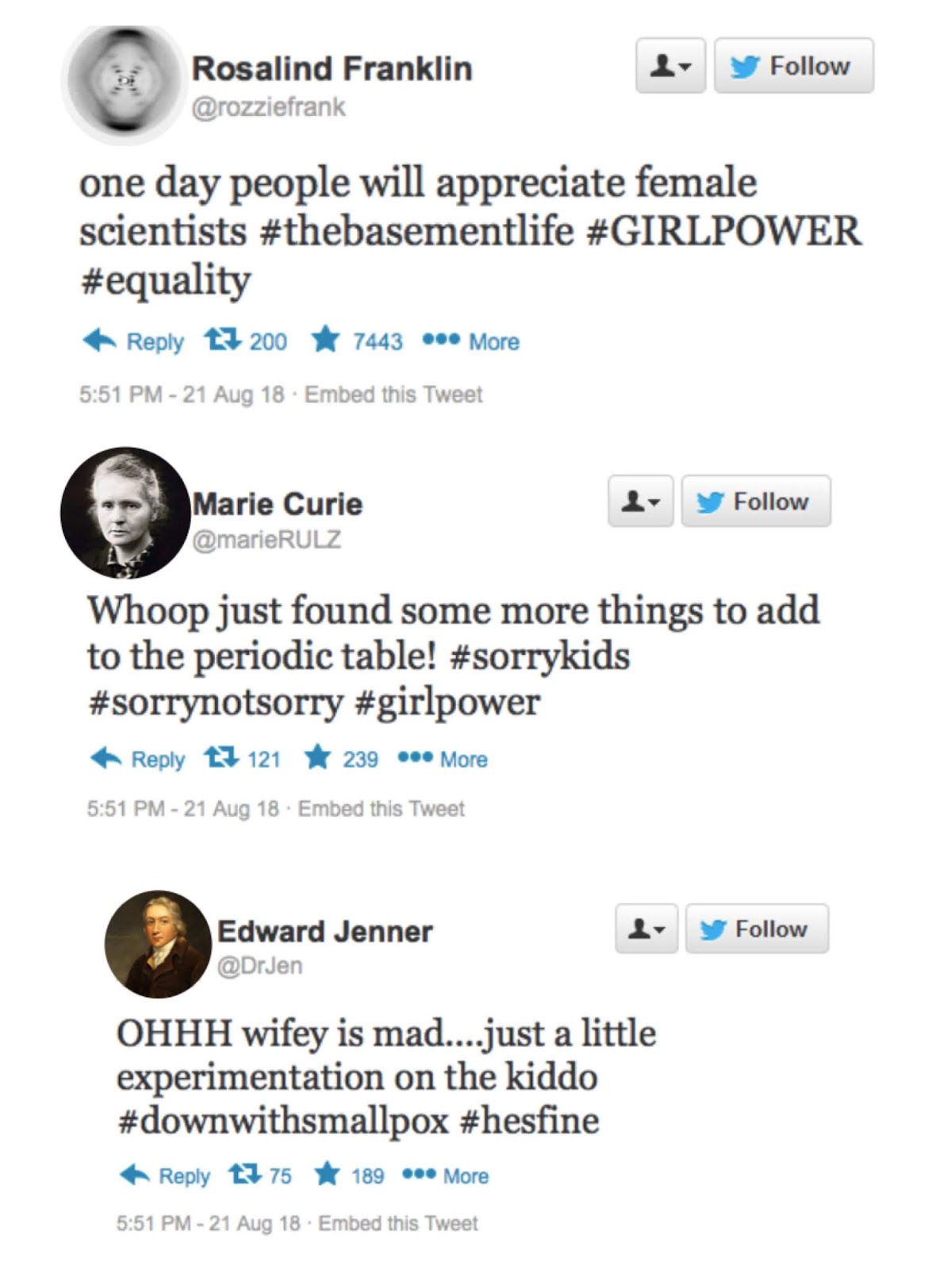
In order to learn how to think like a scientist, students researched scientists and composed a "tweet" from them.

"Our favorite moment from our first week of science is when we got to make a funny science tweet in the perspective of a scientist. It was fun to see what everyone came up with. Even if we didn’t make the winning tweet it was fun working with our friends to come up with an idea like this."
- Shambhavi and Aidan


Wednesday, August 22, 2018

Back to School Sphero Challenge

Our first challenge this year was to see if students could design a device to pick up trash from the ocean.  

"In my first week of school, we started a project in which we created an invention controlled by a Sphero that picks up trash in the ocean. My favorite part about it was that we got to deal with robotics and propose an idea to solve a global cause." 
- Dhroov P

"Our favorite moment in science was when we got to build the Sphero into a trash picking robot and when we tested it out. We also likes how we were surprised when we found out our invention worked successfully by picking up 5 pieces of trash."
- Aarya and Shivani

Thursday, March 15, 2018

Human Body Unit Reflections

After 9 weeks of studying the human body, here are a few favorites from our class...

"My favorite project we did in our study of the human body, was what we did in the immune system. One of the activities we did in the immune system was to show how fast viruses spread. We each got a cup of water and two people had “contaminated” water , but we didn’t know who had the special water. We shared our water using water droplets with each other . Using a special substance over half of our class was affected. This activity showed me how fast viruses and diseases spread."
- Amolika

"My favorite project was coding the Sphero. I loved the challenges of coding the tiny robot."
- Josephine

"My favorite project about systems this year was the Healthy East project. It was when we thought of many ideas to make our campus more healthy. During the project we learned about a couple of new systems and how good food and exercise can effect your body."
- Varun R.

"Our favorite project from our study of the human body was the rat dissection. We enjoyed learning about our body systems through a hands-on project. During the dissection, we could see the parts of the body in a once living animal instead of just a diagram. It gave us a deeper and more relatable experience from which we gained a lot of information. Dissecting the rat was a great way to see and understand the structures of the human body."
- Akshara, Taara, Michelle

"I liked whenever we were learning about our heart rate the most it was very cool. It was cool because we got to test things to see if our heart rate would actually change and we learned why doctors check our heart rate."
- Emily P.


Tuesday, January 2, 2018

External Stimuli Lab

"The external stimuli lab was a fun and interesting project. For the lab we chose a stimuli and tested it against an animal like a roly poly. We found out how they react to different types of music. We learned a lot from the lab. For example when we were researching about the roly polies we found plenty of useful information that helped us with our experiments. One of the important pieces of information that we found said that roly polies have sensory organs that let them hear. On FlipGrid, we respond to the younger kids’ questions that have to do with external stimuli of animals."
- Kushal, Rushil, Yadushan, Rohan

"The external stimuli lab was a lab where we used insects to try to answer questions about external stimuli. We used Madascar Hissing Cockroaches to see how they would react to carrots and lettuce. They liked the carrots better. I thought this lab was interesting because it was my first lab that had a living thing in it. (The cockroach). We also used the lab to answer questions that kindergarteners asked about insects. ( like, why do bumblebees sting?) We collaborated and shared with them using an app called Flipgrid."
- Lingesh

View our project on FLIPGRID here.


Monday, October 30, 2017

Cell Survivor

"In Cell Survivor we were given a organelle to learn about and to present to the class about the organelle. During the competition you had to vote out groups that you thought wasn't important to the cell and couldn't live by itself. During this you were given an immunity challenge which would make it to where your group couldn't be voted out. On the last presentation you say we should win instead of you shouldn't kick us out. Then the other groups voted and then you would get a winner."
- Marissa M.

"The Cell Survivor is a big project that combines the TV show “Survivor” and science to make an awesome competition. You first are assigned a organelle and you use facts to make your’s stand out. The first day, you make a model of your organelle and you make a quick presentation. The better the presentation, the better the chance of your “survival”. Everyday people get out based on what other organelle’s think. You can also get immune which means no one can vote you out. Everyday, you take a small quiz. The group that gets the most right and turned it in the quickest, they would get immune. The Cell Survivor is a project that I loved and I will never forget it!"
- Shreya R.


Cell organelles created out of recycled and repurposed items and then photographed and edited using the app Prisma.


Thursday, October 19, 2017

Cells Lab

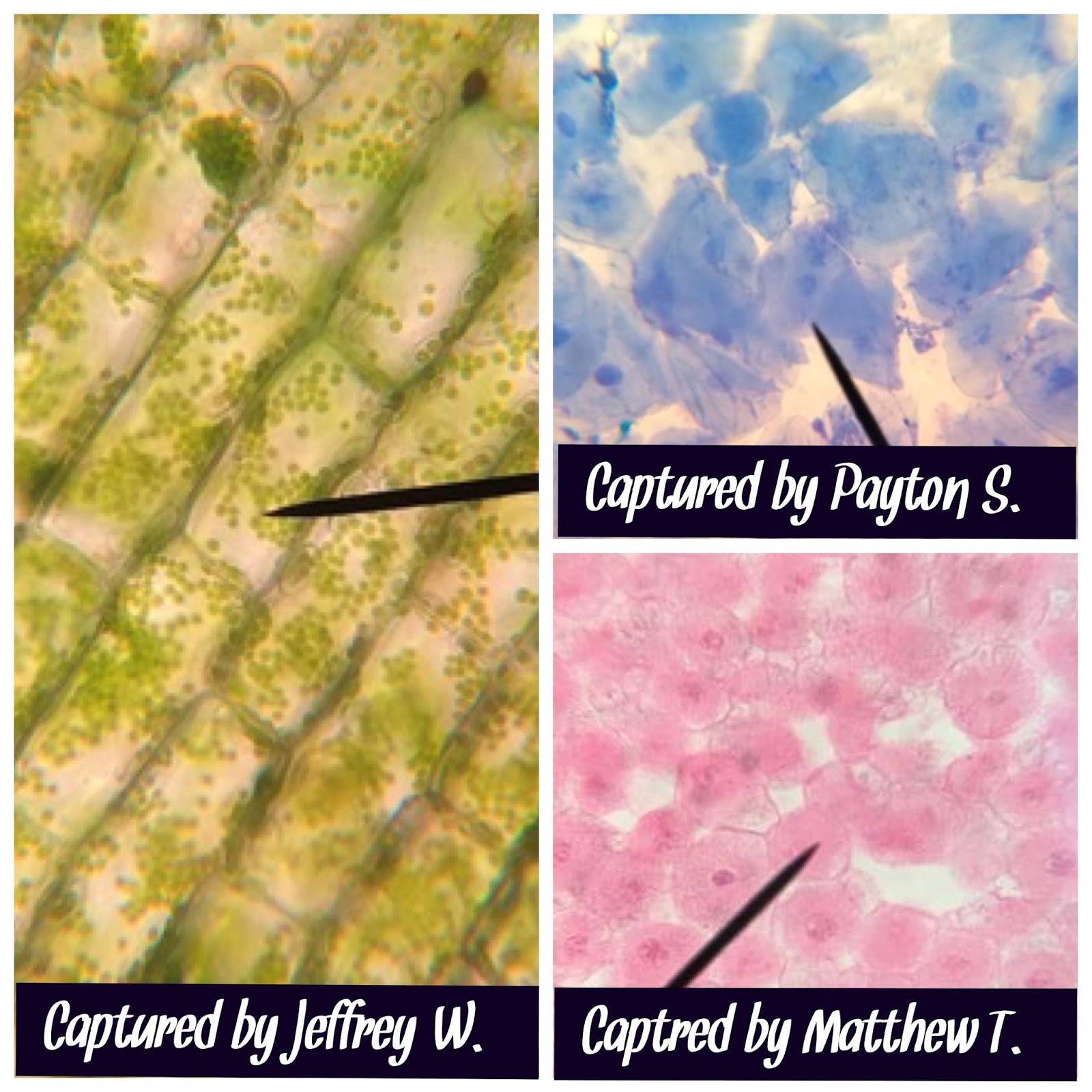
"Cells are magnificent parts of every living thing. Studying them helps us learn more about the world around us. To go more in depth, we had done a lab to teach us about differences between animal in plant cells. We took and Elodea leaf and human cheek cells and examined them under a microscope. This helps us realize where the different organelles of the cells were. All in all, the cell lab was an essential part to our science adventures."
- Shrayas and Roma

"The cell lab is where we explored prokaryotic and eukaryotic cells to find and identify different parts of a cell. We found out that most parts of a cell were present in both plant and animal cells, but none were only unique for animal cells. We also learned that every part of the cell plays an important part that helps the cell function properly. We explored different cells and how the parts of a cell can be identified. This lab is also a proof that living things have cells in them. What we finally had to take away from this lab is that cells play an important role and they have cell parts that help the cell function, we also learned the difference and similarities between plant and animal cells."
- Sai Y.

"This week we have been learning about prokaryotic and eukaryotic cells, as well as their functions. We did a lab about the cells and how Animal and Plant cells differ and relate to each other. For example we learned that plant cells can only have cell walls, and most living cells have an nucleus, which manipulates the cell. We also further expanded our knowledge of the use of microscopes. The was a extremely memorable learning experience!"
- Payton H and Josephine

"In the cell lab we got to use a microscope to magnify different organisms to up to 400x. We got to see the different types of cells up close and we even got to see the cell wall and chloroplasts up close and also got to see the nuclei. We also got to see our cheek cells up close. We got to see the nuclei of each cell in our cheek."
- George P.


Friday, September 29, 2017

Microscope Lab

"We did the Microscope Lab. First we learned the scientists who made the microscope and helped develop the microscope. We learn that the magnification is objective times 10. We also learn parts of the microscope such as the arm/neck, base, diaphragm, ocular, and some more. We also looked into various substances such as bird blood, heart muscle, tissue and much more."
- Harsha and Shriram

"During the microscope lab I viewed monkey's tounge and heart muscle which looked very cool under the microscope. I also learned that the eyepiece is actually called the ocular."
- Richa
Look at these amazing images that students captured on their phones or iPads through the ocular of the microscope!


Wednesday, September 27, 2017

Stomach vs Soda

"We are doing an experiment called Stomach vs Soda. This experiment is about how sodas affect the human body, so we are using a cow tissue as our model. Our goal is to figure out how effective sodas can be on cow tissue to see it kids should decrease their intake of sodas and energy drinks. This experiment has a true meaning behind it and it shows us that sugar is not good for our body."
- Sansu, Shreyas, Abhiram

"We are learning about how sugar affects the body tissue. So far, we learned that the sugar in sodas can cause several health issues. Over the course of the lab, we'll be able to find out how the tissue is affected by sugary drinks."
- Yuna, Meghna, Neha, Nicki


Video created by Harish

Friday, September 1, 2017

Epic Fails

"In Science we did a fun project called Epic Fails. We had to use a app called FlipGrid that we would video ourselves talking about a fail. I learned that not everyone is perfect and that even grown ups can make huge mistakes. Also, most fails are hilarious.
- Bella M.

"Can you imagine that your mistakes and fails are celebrated instead of punished? Well this assignment made our fails great achievements. This week we filmed and posted a video of ourselves admitting one of our epic fails. Now every time you ,or your friend, or your family makes a mistake learn from it, celebrate it, and don't do it again."
- Megan P.

Check our our Epic Fail Videos by clicking HERE or watching below!


Thursday, August 24, 2017

Sphero Challenge

"The beginning of the year started of with a great project. We started of by coding a Sphero robot. A Sphero is a ball-like robot that rolls around. How it moves is decided by the code. We used a block code and used an app called Sphero edu. This project was group project in which all the groups would compete to be the first to code the Sphero to roll into a marked area. Our group was actually the first to win and we had a lot of fun in doing so. This activity taught us about trial and error, and going around obstacles. This was a lot of fun and led us to think that this would be a great and fun filled year in science."
- Zach, Gavin, Cooper, and Ruchir

"The Sphero was very challenging because we had a very hard track with a lot of twists and turns. The distance between the starting point and the ending point was very long. There were also some difficulties in the challenge, such as binders and feet in he way. We had to use many different codes and blocks to get us in the box. It took us many tries to complete the challenge, and every time we tried we got closer. When we finally completed the challenge, we felt relief because we succeeded. This taught us about trial and error and how we would have to make changes to our code. With each new piece of code came a new challenge and it was really fun to try and get around our obstacles."
- George, Rushil, Akanksh, Mac


Wednesday, April 12, 2017

Sketchnoting Genetics

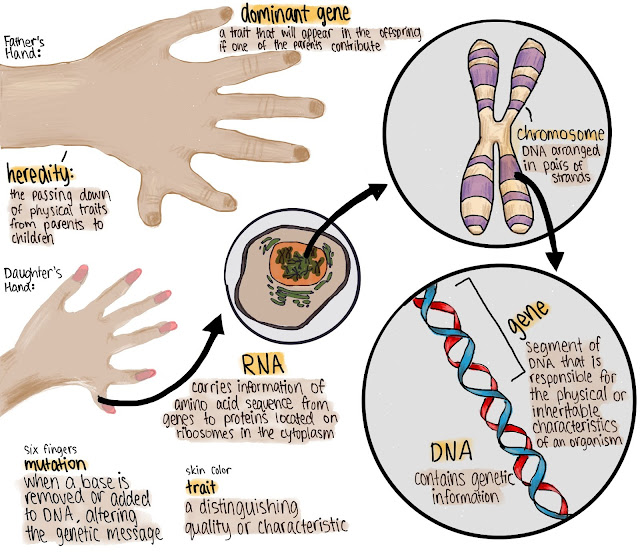
Students created sketchnotes and thinking maps to show their understanding of genetic terminology. Check out some of their awesome work!
Created by Landry
Created by Tia

Created by Harika 
Created by Kinley

Monday, April 10, 2017

Mutant Squirrels

"Yesterday we did a lab about genetically mutated species. Each table had a different mutation, and we all tried to get candy. The Candy represented Food in the Wild. Some mutations helped like having an extra hand, but some mutations killed, like fork fingers. I learned that mutations can help and hurt the animals in an environment. If we do not take care of the wild, bad mutations can develop. In the end, most survive, but future mutations might end up driving some species extinct."
- Emily H. and Lindy C.

"We did a squirrel mutation lab on April 5, 2017. In this lab, we gave squirrels "mutations" such as fork fingers, three hands, and no thumbs. The worst one was the fork fingers because it was very hard for the "squirrel" to get food. The best one was the three hands because it was already easy with two hands, and it got even easier with three. We learned that mutations may be beneficial for the animal or bad for the squirrel."
- Sownthar P. and Mihir C.

"Yesterday, we did a simulation relating to mutations. Each group was a squirrel that was mutated differently, and we had to collect and open candy (food) from a common food source. I learned that mutations are different form adaptations because mutations are when DNA gets changed in good or bad ways. Organisms that had helpful mutations actually survived and the organisms that had mutations that were a hindrance to their food-eating ability died out. Also, food that was easier to consume usually ran out more."
- Prerana


*Special thanks to all the parents that donated candy for this lab. We really appreciate it!


Friday, April 7, 2017

World Water Day

In honor of World Water Day, CMSE students worked with 23 different schools around the world to test and compare water quality.  We developed "I can" statements to share how we would conserve water and stop water pollution.  Here are some of their thoughts.

"Our World Water Day Project was so much FUN! We went through some really cool stations with some really cool technology, thanks parents for donating money! We got to look at lake water near us, and we actually found a Protist, which is a one cell organism. It was so cool to see microscopic bugs, and organisms in the water, but it was also kind of gross! Whenever you accidentally drink some of the lake water, that is going in your mouth!"
- Emily H.

"Our world is in danger of losing our fresh supply of clean water. It is projected that we will lose all our water in the next decade. We have to stop and take action. Coppell Middle School 7th grade science students are interacting with many other schools across the earth to help save our water for future generations. We have been testing lake water and also learning new and exciting ways to preserve and purify our water."
- Shriya D. and Adrianna B.

We shared our learning with others using an app called FlipGrid. See everyone's responses here!